
The AI system of action for the surgical case.
Spexo walks the care team into every case already knowing the patient, documents the case as it happens, and closes it bill-ready the same day.
We start with anesthesia, where the record, the coding and the revenue all meet. Other specialties follow on the same platform.
We have a working prototype. The product is in development.
The problem
Surgery centers, anesthesia groups and hospitals often chart on paper, and their systems don't talk to each other.
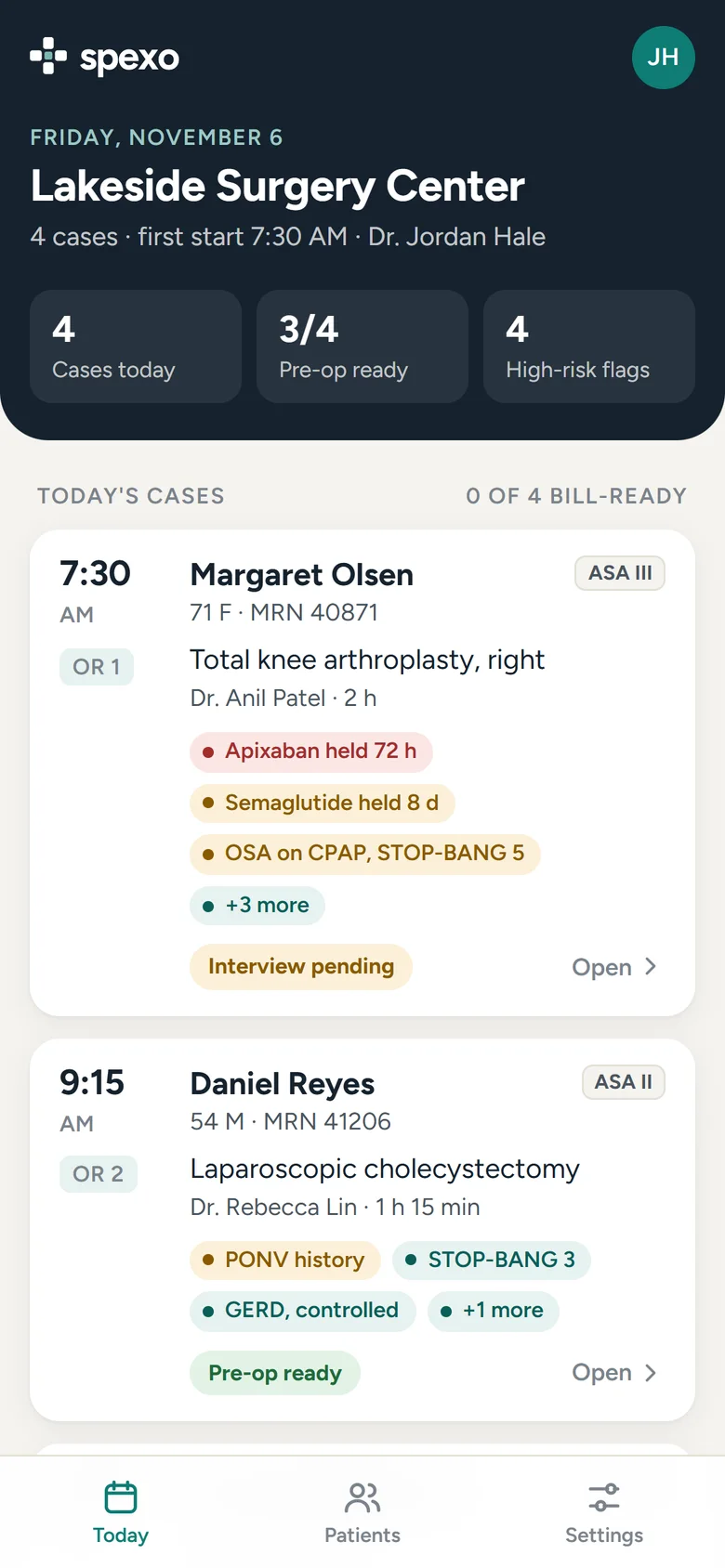
The team meets the patient blind.
The history lives in someone else's system. The first real conversation with the patient happens in pre-op holding, minutes before the case.
Cases get cancelled on the day.
When something surfaces in holding, the case can get cancelled. A day-of-surgery cancellation is the most expensive thing that happens in a surgery center.
Billing lags weeks.
Charges wait while paper is collected, read and coded by hand.
Revenue leaks.
Missed modifiers, post-op pain blocks that never get billed, and denials nobody appeals.
Today's software digitizes the chart and fixes none of this.
How it works
One case, start to finish.
From the call before surgery to bill-ready the same day, on the provider's own phone. Our AI does the work instead of putting it on someone's list.
1
It calls and interviews the patient.
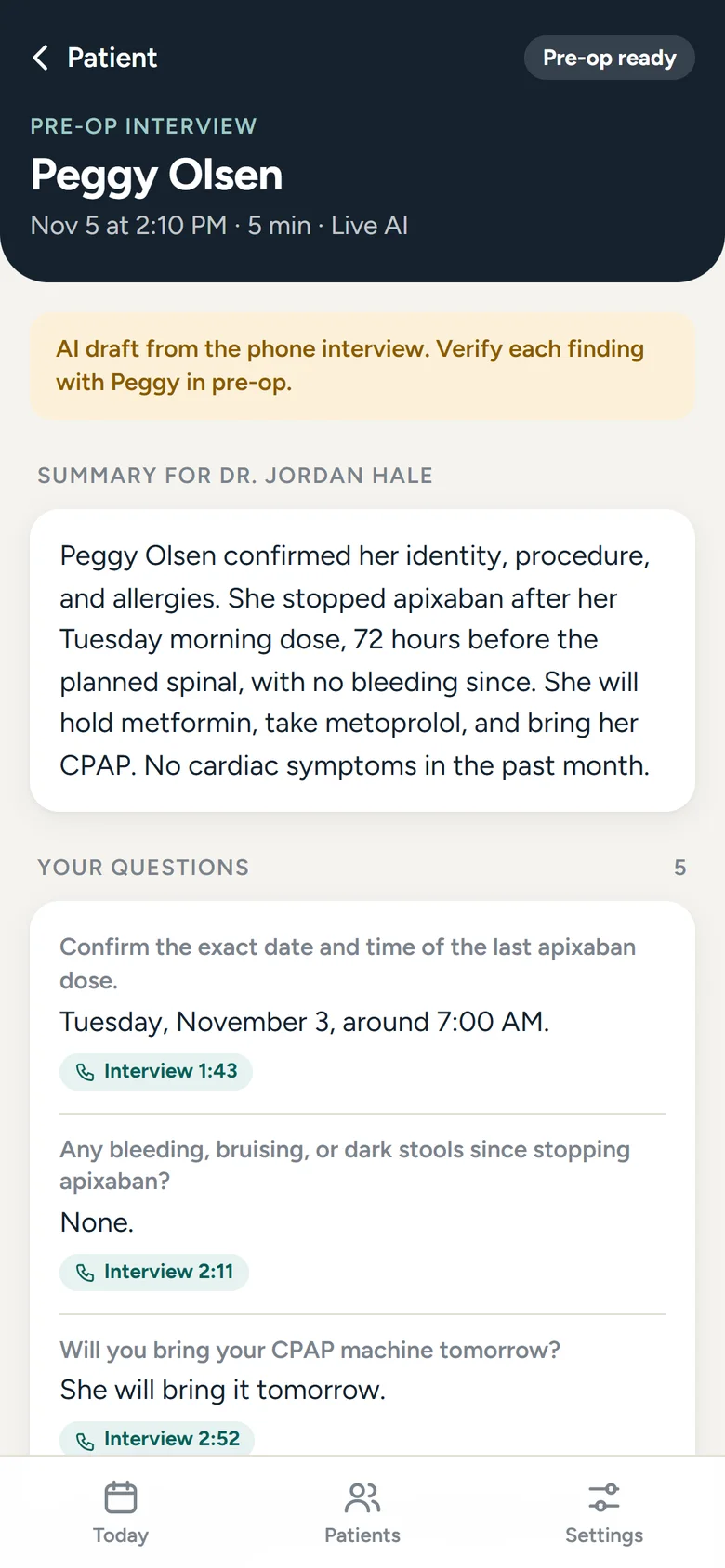
A day or two before surgery, our AI calls the patient and holds a real conversation. It takes their history and asks the provider's questions.
2
It puts the history on one screen.
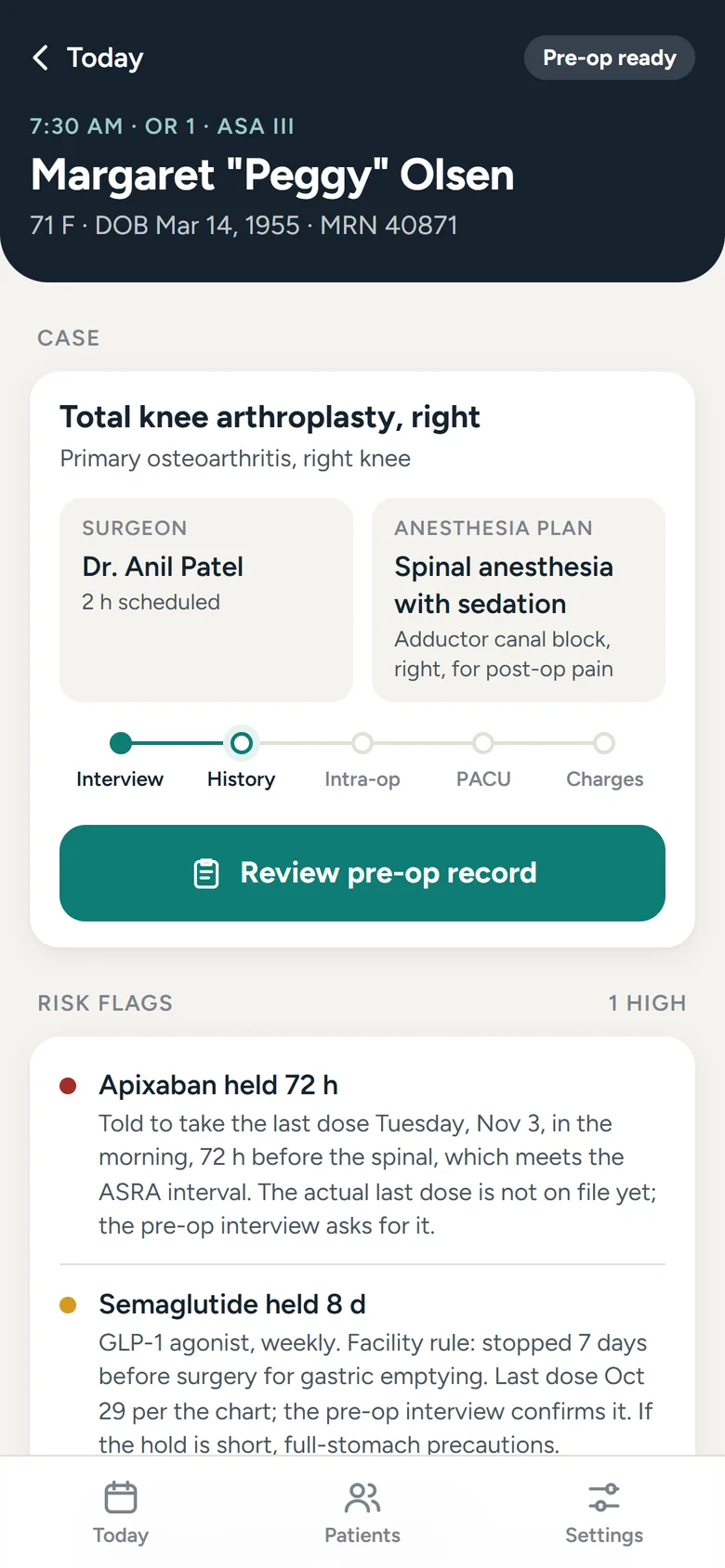
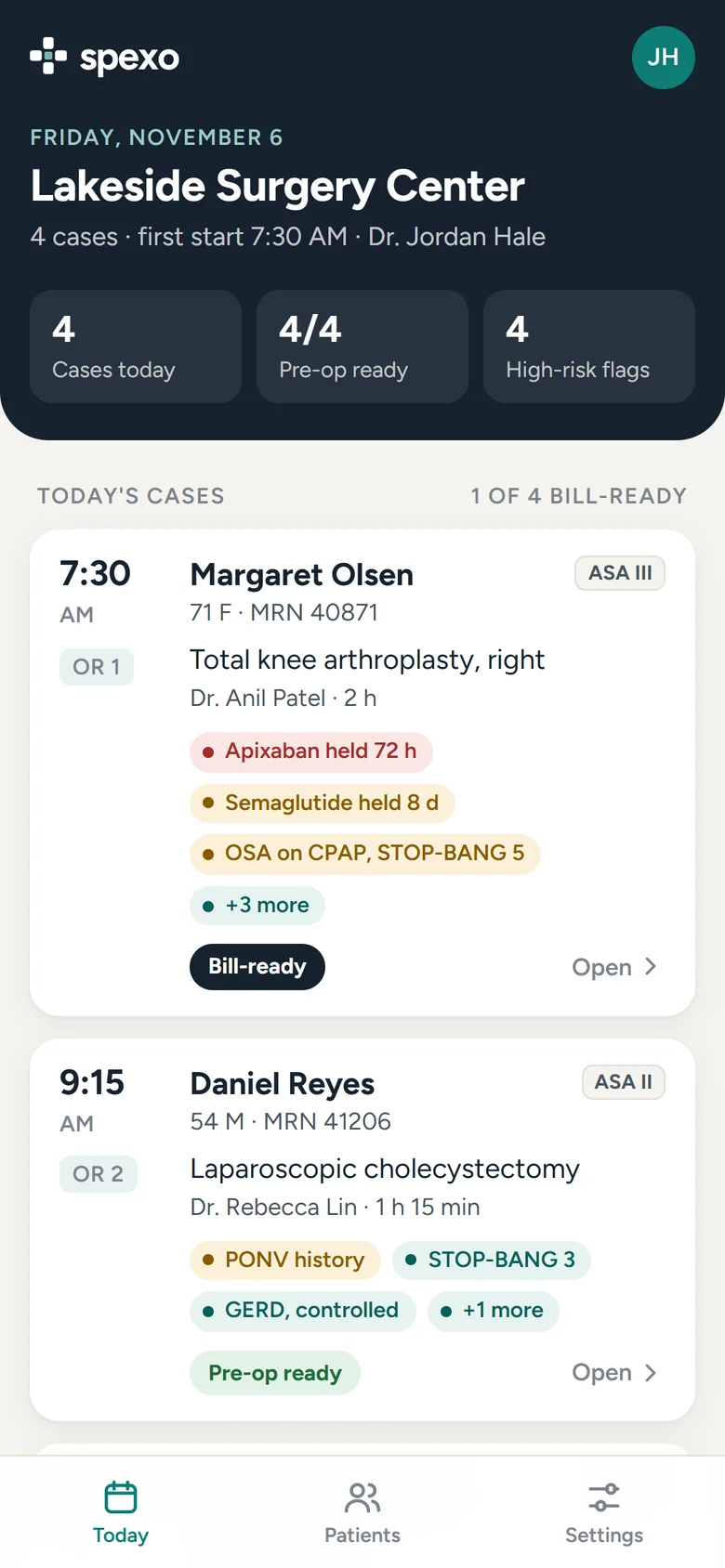
When the provider opens the case, the history is on one screen with the risk flags marked, and the record is already started.
3
It documents the case by voice.
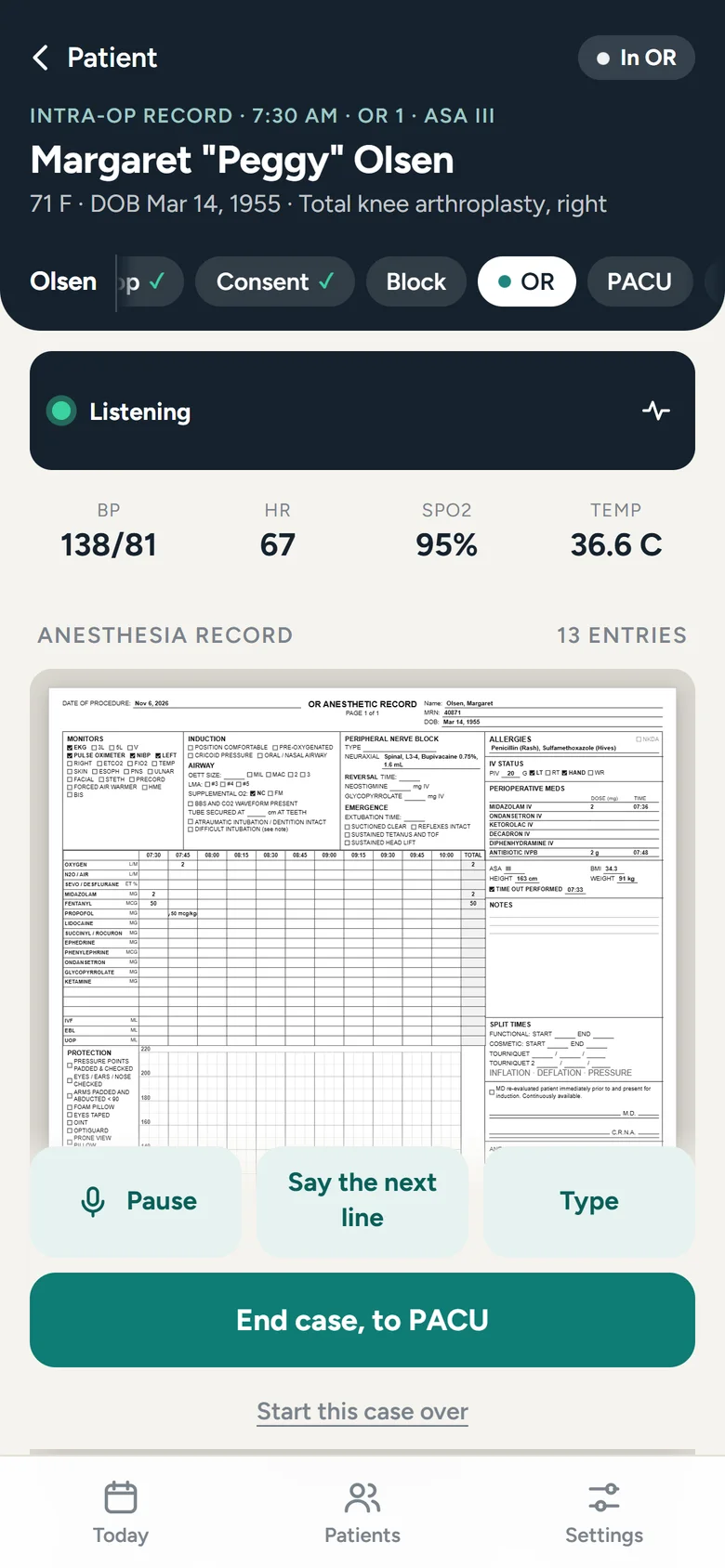
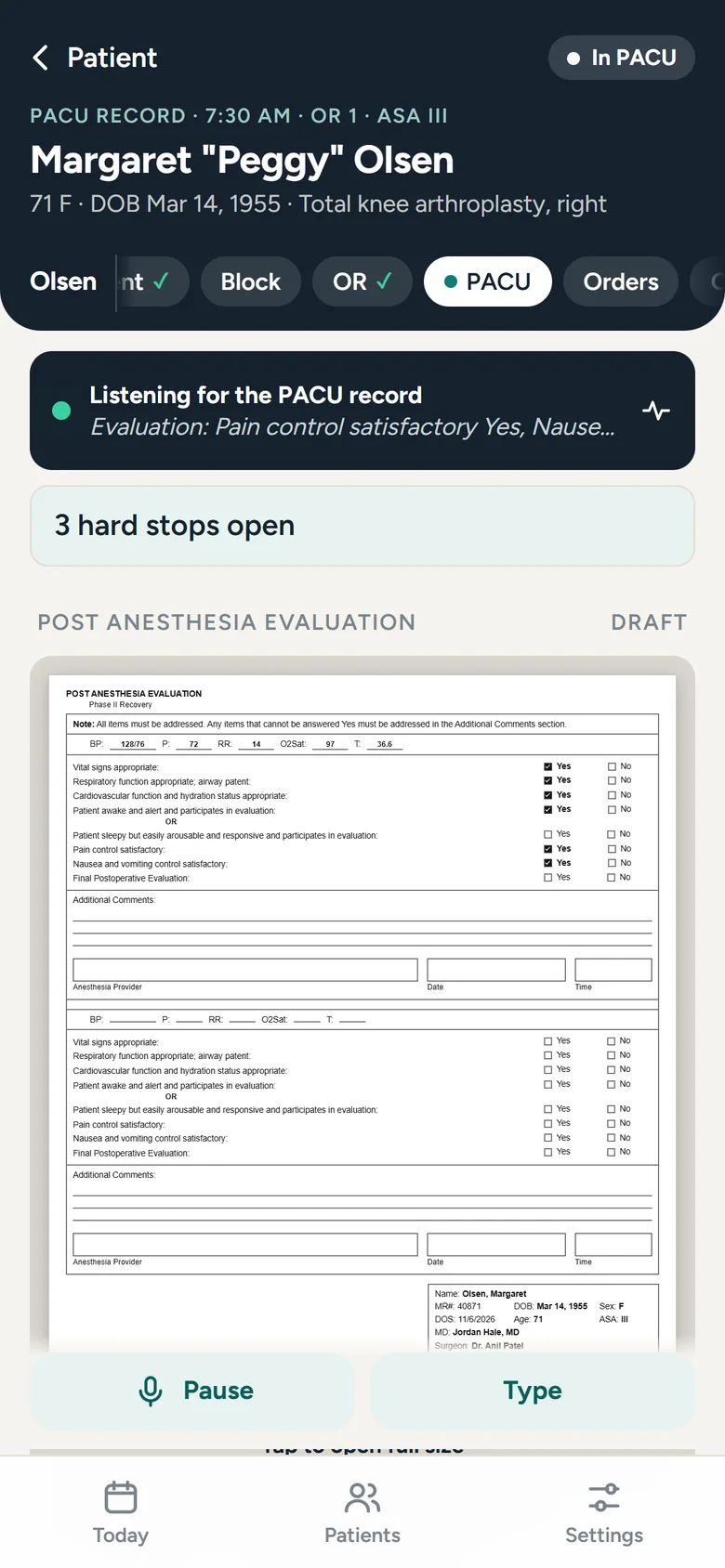
Our ambient voice scribe runs through pre-op, the OR and recovery. The provider says what they are doing, and each line lands on the record with its time. Faster than paper, with very little to type.
4
It codes the case the same day.
The provider reviews and signs. Spexo produces fully coded charges for the billing company the same day.
In anesthesia, that looks like this
Before
The history and physical, plus the questions an anesthesia provider wants answered: medications, allergies, the last dose of a blood thinner, sleep apnea, who is driving home.
During
- "Versed 2, fentanyl 50."
- "Spinal at L3-4."
- "Incision."
After
The anesthesia code, base and time units, modifiers, and the post-op pain block captured as its own line.
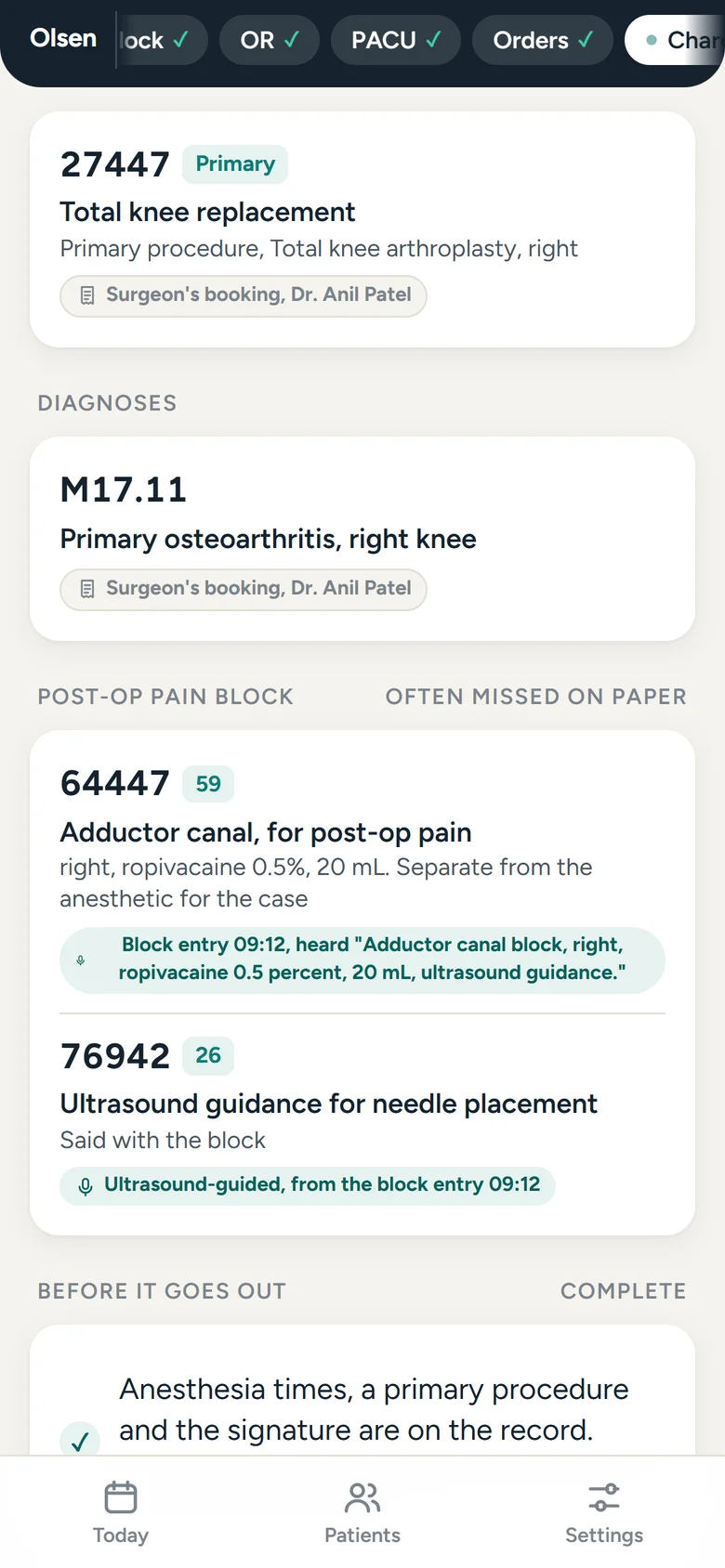
Screens are from our working prototype and show fictional patients.
For the facility
Built for the facility's workflow.
We are building Spexo to streamline the whole perioperative workflow, so patients are ready when they arrive, cases start on time and documentation stops holding up turnover. In quick-turnover rooms like endoscopy and cataracts, minutes saved on every case add up to more cases a day, and more cases are revenue for the facility.
Why a platform
A platform, not a chart.
The AI carries the task to done.
Today it calls the patient and takes the history. Next it will chase the missing cardiac clearance, confirm eligibility and send pre-surgery instructions, instead of putting each on a nurse's list.
Not built on an old EMR.
Spexo is designed for AI agents that act, with information moving both ways between Spexo and the facility's system of record.
One case, linked end to end.
We are building every case to be linked from pre-op, through the case, to the claim and whether it was paid. That loop carries to the next specialty on the same platform.
What changed
Three things changed. The systems in use predate all of them.
Voice AI can hold a real conversation.
An AI can now call a patient, talk naturally, understand the answers and ask the next question. That is what makes the pre-op interview possible.
AI can carry a task to the end.
Instead of adding "call the patient" or "chase the clearance" to someone's list, it can do the task and report back.
A patient's records are reachable.
National record exchange, through TEFCA and FHIR, means a patient's history can be pulled from the systems that hold it. We haven't built that part yet, but it's what makes it possible.
The phone
On the phone already in the provider's pocket.
Spexo is the system of action on top of the facility's EMR. It runs on the provider's own phone. Not a tablet or a computer. It goes with them from pre-op to the OR to recovery.
In anesthesia, Spexo is the record of truth: no separate paper or hospital anesthesia record. We are building it to integrate with the facility's EMR, so the patient's record is complete in one place.
Trust
Advisory only. The clinician decides and stays in control.
Reviewed and signed.
Nothing Spexo writes is final until the provider accepts it. Drafts are marked as drafts, edits are kept, and the provider signs the record.
Every item cites its source.
Each history item, risk flag, record entry and charge code shows where it came from: the interview, a prior record, or the words spoken in the room and the time they were said. One tap opens the source.
Flags are advice.
Spexo checks the case and flags what looks out of line. The clinician weighs it and makes the call.
Where we are
Where we are
We are still building Spexo. Here is what works today and what comes next.
Working today, in our prototype
- The AI phone interview, as a live voice call
- The patient's history on one screen, with risk flags
- The voice scribe across the pre-op record, the OR record and PACU
- The coded charge sheet, with the pain block captured
What comes next
- Pulling the patient's records from the outside systems that have them
- Writing the finished record back to the facility's EMR
- Pilots at our first facilities
Who it is for
Who we are building it for
Hospitals and surgery centers
Patients are interviewed before they arrive, so risk flags surface a day or two ahead, not in pre-op holding.
Anesthesia groups
Your providers start each case with the history done and end it with the record done. Charges are coded the day of the case.
Billing companies
Spexo does not submit claims. It hands your team fully coded charges for each case, with the source behind every line.
Our first pilot facilities are lined up. We are looking for a few more pilot partners. Become a pilot partner
The film
Watch one case, start to finish.
Two minutes. A fictional patient on our working prototype.
Talk to the foundersTeam
We've run an anesthesia EMR and an anesthesia practice. We know the surgical day from both sides.

Brian Williams
Co-Founder & CEO
Brian leads the business and Spexo's product. He has over 20 years in healthcare: consulting at PwC, Wall Street healthcare equity research at Credit Suisse and UBS, then executive roles scaling startups and leading turnarounds across providers, digital health and fintech, including pain management and 11 years leading an anesthesia EMR.
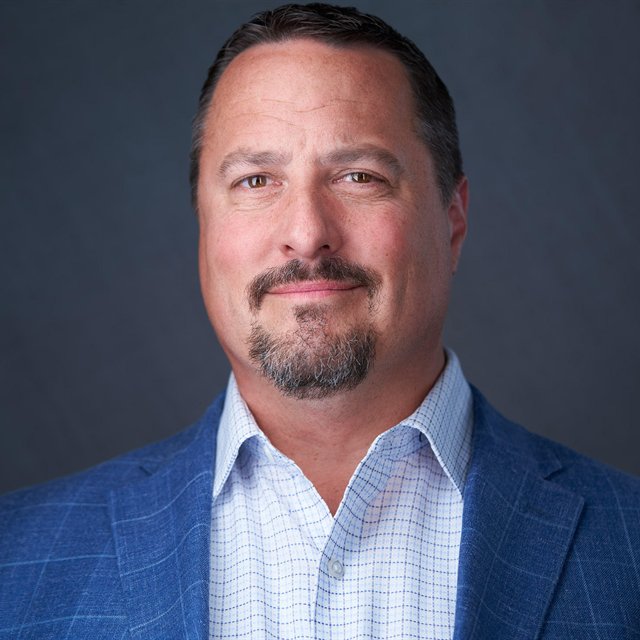
Chris Copley, CRNA
Co-Founder & President
Chris is a CRNA who leads clinical and business development. He founded Capital Anesthesia Solutions, sold it to Sound Physicians and then served as President of Sound's anesthesia business. He spent 23 years across the Navy, Marine Corps, Army and Air National Guard, including Desert Storm and two deployments to Iraq, one as chief anesthetist.
Spexo Inc. is based in Nashville, Tennessee.
Get in touch
Talk to the founders.
Tell us who you are and what you run. We will show you the prototype running a case.
Thank you.
Brian or Chris will be in touch.